
VHH Discovery Platform
Unlocking High-Performance VHH Nanobodies Through FC8TM and Immune Discovery Routes
We combine FC8TM synthetic discovery, powered by ribosomal display and phage display, with immune library discovery, to deliver fast, reliable, and application-ready binders for imaging, therapeutics, diagnostics, and cell-based engineering.
FC8™ Synthetic Discovery: Ribosomal Display + Phage Display
Our primary discovery route, and the fastest path to a clinical-ready lead. Every campaign starts within the FC8TM scaffold, screened first through ribosomal display across a functional diversity of up to 1014 variants, then carried seamlessly into phage display for precise enrichment and selection.
Key advantages:
- Immediate project start, no immunization required
- Up to 1014 functional diversity via ribosomal display
- Engineered for solubility, stability, and >90% humanization
- Ideal for toxic, non-immunogenic, or difficult antigens
- Highly controlled design enabling efficient downstream engineering
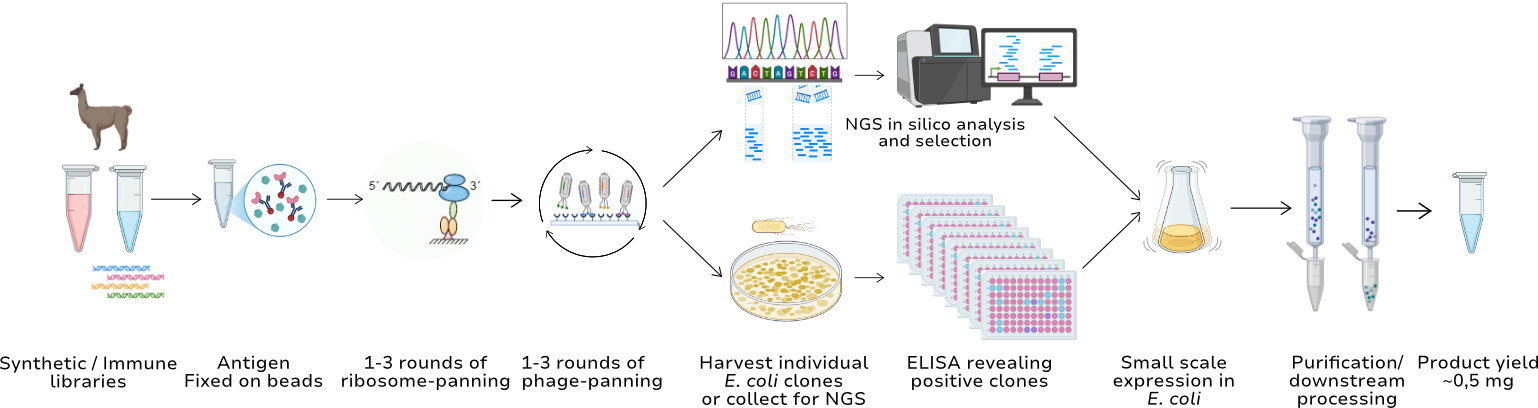
The Cortalix discovery workflow combines FC8™ synthetic and immune VHH libraries with phage display. After multiple rounds of phage panning and screening, including optional assays on intact cells, unique binders are identified. Clones are validated by ELISA-based affinity measurements and DNA sequencing to ensure optimal candidates for downstream development.
Immune Library Platform
Cortalix maintains high-quality immune VHH libraries generated from immunized llamas or alpacas, coordinated by Cortalix and performed at certified partner facilities. This route is preferred when affinity, specificity, or complex target recognition is essential.
Strengths:
- Naturally affinity-matured binders
- Broad epitope coverage
- Excellent performance on membrane proteins and complex targets
- High success rate for advanced or conformational epitopes
CDR Grafting & Framework Optimization
When top binders come from immune libraries, CDRs can be grafted onto our FC8TM framework.
Benefits:
- Improved humanization
- Increased stability and expression yield
- Consistent performance across downstream engineering steps
This provides a strong developability foundation for every selected VHH. The final biophysical properties remain dependent on the unique CDR sequences of each binder and are therefore evaluated during lead characterization.
Why Use These Platforms?
- Combining FC8TM synthetic and immune library discovery provides:
- Maximum epitope coverage
- Higher probability of success across antigen classes
- Superior diversity and binder quality
- Flexible project design tailored to the target
This dual‑platform approach strengthens downstream applications such as MultiDome™ multispecifics, AlbuFlex™ half‑life extension, and CARVex™ nanobody-based CAR-T targeting.
Why don’t we claim that every FC8™ VHH is non-aggregating?
The intrinsic biophysical properties of a VHH are determined by two distinct components: the framework and the complementarity-determining regions (CDRs).
The FC8™ framework was engineered for favourable developability, including high thermal stability, efficient refolding after thermal stress, absence of known sequence liabilities, and a low intrinsic aggregation propensity as predicted by computational (in silico) modelling.
However, the antigen-binding CDRs are unique for every selected VHH and contribute substantially to the overall physicochemical behaviour of the molecule. Depending on their amino acid composition and three-dimensional structure, CDRs may influence solubility, self-association and aggregation behaviour.
For this reason, while the FC8™ framework provides a robust developability foundation, the aggregation propensity of the final VHH is ultimately determined by the combination of the framework and its unique CDR sequences. Consequently, aggregation behaviour should always be assessed for individual lead candidates during developability studies.
Discovery Workflow
Our standard discovery workflow includes:
-
Antigen QC & preparation
-
Library selection (FC8TM synthetic, immune or hybrid)
-
Phage display panning — including optional cell-based panning
-
High-throughput clone screening
-
Binding validation (ELISA/BLI)
-
Sequence analysis & developability assessment
-
Optional reformatting (bivalent, Fc-fusion, NIR-labeling)
The entire workflow is modular and can be adapted to any project design.
Deliverables
Typical project outputs include:
-
Validated VHH Nanobody sequences
-
Purified VHH proteins (optional)
-
Full binding dataset and QC report
-
Developability assessment
-
Optional reformatting into bivalent, trivalent, Fc-fusion, or imaging-ready constructs
From Discovery to Application
VHHs generated in this platform seamlessly feed into Cortalix’s engineering suite:
-
MultiDome™ Multispecific engineering
-
AlbuFlex™ Albumin-binding half-life extension
-
CARVex™ VHH-based CAR-T targeting
-
NIR imaging probes
-
Assay and ELISA development
This ensures a smooth path from binder discovery to translational application.
Tailored for Industry and Academia
Cortalix provides flexible partnership structures, ranging from fee‑for‑service projects to collaborative programs. Our Discovery Platform is designed for:
-
Biotech and pharma target discovery programs
-
Imaging probe development groups
-
CAR‑T and cell therapy teams
-
Translational research institutes
Start your VHH discovery project
Contact us to discuss your target, project design, or antigen strategy. We help you select the optimal discovery route, synthetic, immune, or a hybrid approach, to ensure strong outcomes and fast progression toward application-specific engineering.