
Phage Display for VHH Nanobody Discovery
Efficient selection and screening of high-quality VHH Nanobody binders
Cortalix provides VHH phage display for the discovery and selection of Nanobody binders from synthetic and immune VHH libraries. Phage display combines iterative target-based selection with efficient enrichment, clone screening and sequence identification, providing a robust route from large VHH libraries to individual lead candidates.
Our phage display workflow can be used as a standalone VHH discovery technology or integrated with ribosomal display for projects requiring access to even larger initial library diversity.
Why Phage Display for VHH Discovery?
Phage display is a powerful and well-established technology for selecting VHH Nanobodies against a wide variety of biological targets.
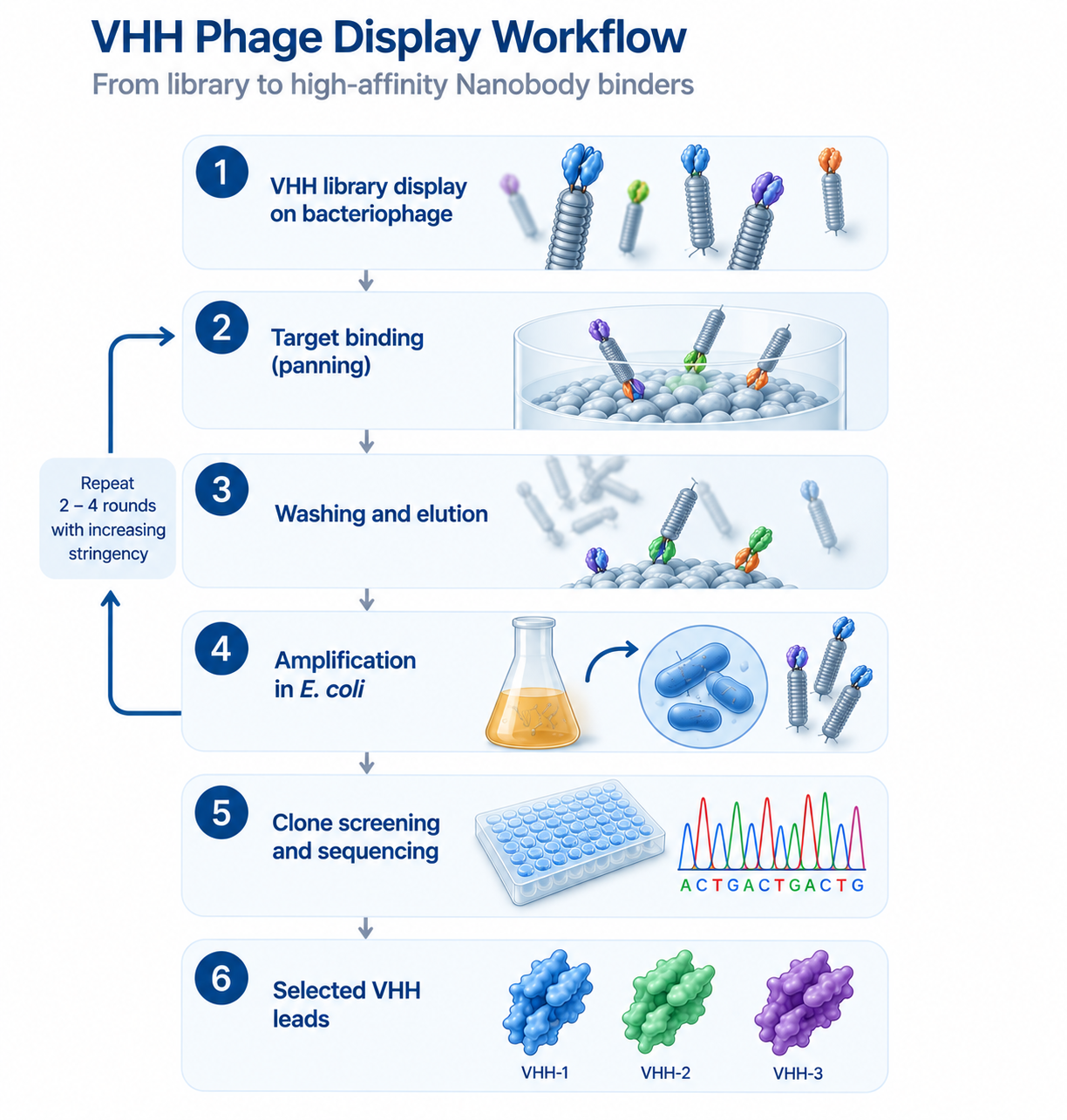
VHH sequences are displayed on bacteriophage particles while the corresponding genetic information remains physically linked to each displayed binder. This genotype–phenotype linkage enables iterative selection against the target of interest and efficient recovery of enriched VHH sequences.
Through successive rounds of panning and increasing selection stringency, target-specific VHH populations can be enriched from highly diverse starting libraries.
Phage display is particularly valuable because enriched libraries can subsequently be screened at the individual clone level, allowing direct identification and characterization of promising VHH binders.
Cortalix Phage Display Workflow
VHH Library →
Phage Display →
Target Panning → Enrichment →
Clone Screening → Sequencing →
VHH Characterization
Cortalix performs iterative phage display selection against the target of interest. Selection conditions and stringency can be adapted to the characteristics of the target and the objectives of the project.
Enrichment can be monitored during successive selection rounds before individual clones are isolated for screening.
Depending on the project, screening can include polyclonal and monoclonal ELISA, followed by sequencing of positive clones and identification of unique VHH candidates.
Selected VHHs can subsequently be recombinantly expressed and characterized for binding, specificity and other relevant properties.
Synthetic and Immune VHH Libraries
Cortalix uses phage display with both synthetic VHH libraries and immune VHH libraries.
Our synthetic discovery platform provides immediate access to highly diverse VHH sequences without the need for animal immunization. Synthetic libraries are based on optimized VHH frameworks, including the Cortalix FC8™ framework, and can provide a rapid route to novel binders.
For projects where an immune response offers particular advantages, Cortalix can generate immune VHH libraries following llama or alpaca immunization. These libraries capture in vivo affinity maturation and can be particularly useful for complex biological targets.
The most appropriate discovery route is selected according to the target, application and project objectives.
From Panning to Individual VHH Binders
Following phage display selection, enriched VHH populations can be evaluated using conventional clone screening or sequence-based approaches.
Individual colonies can be picked and screened by monoclonal ELISA to identify target-binding clones. Positive clones are subsequently sequenced to identify unique VHH candidates.
Where appropriate, next-generation sequencing can provide additional insight into enrichment patterns and sequence diversity during the selection process.
This combination of iterative selection, functional screening and sequence analysis enables efficient prioritization of VHH candidates for downstream characterization.
Combining Phage Display and Ribosomal Display
Phage display and ribosomal display provide complementary advantages for VHH discovery.
Phage display offers robust iterative selection and straightforward transition to individual clone screening. Ribosomal display is cell-free and removes the bacterial transformation bottleneck, enabling access to substantially larger initial library diversity.
Cortalix can combine both technologies within a single discovery strategy. Ultra-high-diversity VHH populations can first be explored using ribosomal display, followed by phage display for further enrichment, clone isolation and functional screening.
From VHH Discovery to Lead Candidates
Identifying a target-binding VHH is only the beginning of the development process.
Cortalix supports VHH projects from initial discovery through recombinant expression, characterization and further engineering. Selected VHHs can be developed into mono-, bi- or multispecific constructs and adapted for applications including therapeutic targeting, molecular imaging, radioligand therapy, CAR-T targeting and bioanalytical assays.
Additional engineering strategies can include humanization, affinity optimization, half-life extension and site-specific conjugation.
Start a VHH Discovery Project
Looking for VHH Nanobodies against a new or challenging target?
Contact Cortalix to discuss the most appropriate discovery strategy for your project.