
Car-T VHH Platform
CARVex™ – Optimized VHH constructs for next-generation CAR T therapies
What is CARVex™
The CARVex™ platform leverages the unique properties of VHH Nanobodies, built on our proprietary FC8TM scaffold framework, to design optimized constructs for Chimeric Antigen Receptor (CAR) T cells. Unlike conventional scFvs, VHH Nanobodies lack the hydrophobic interface between heavy and light chains, making them more stable, easier to express, and less prone to aggregation.
Key Features
Optimized CAR designs
FC8TM-derived VHH Nanobody-based CARs are engineered for high expression, folding stability, and efficient target recognition.
Controlled tonic signaling (PCP optimization)
Constructs are fine-tuned for their physicochemical properties (PCP value) to minimize excessive tonic signaling. This reduces the risk of premature T-cell exhaustion and supports long-term therapeutic activity.
Superior biophysical properties
VHHs are compact, soluble, and highly stable, reducing issues often observed with scFv-based CARs.
Flexible targeting strategies
-
- Monospecific NanoCARs: single VHH targeting one antigen.
- Bispecific or tandem NanoCARs: multiple VHHs in one construct, enabling simultaneous recognition of different epitopes or antigens.
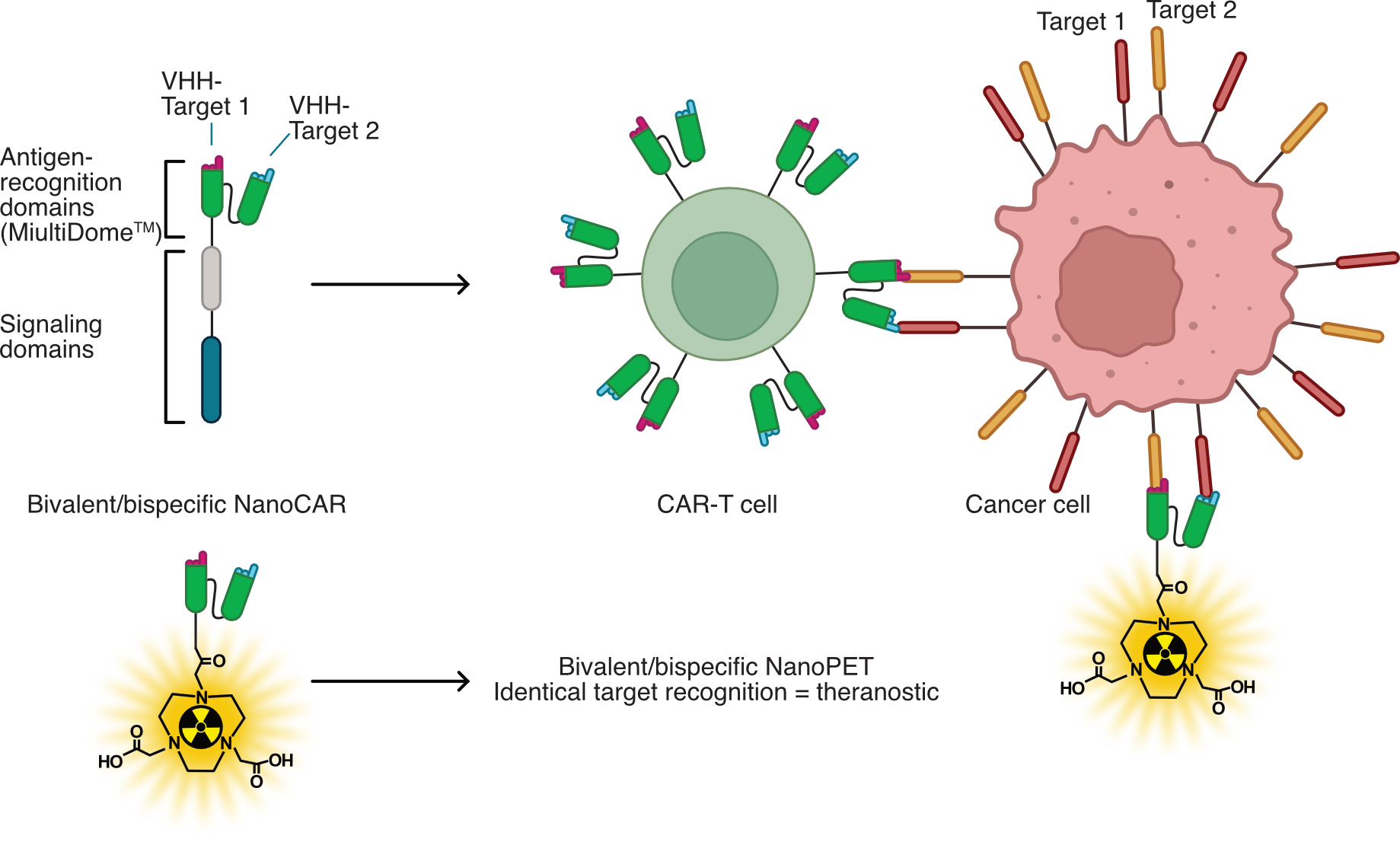
Figure: Example of CARVex™ constructs containing two VHH domains, optimized for physicochemical balance (PCP value) to ensure controlled tonic signaling in CAR T cells. The same VHH construct can be extended to a PET imaging diagnostic by introducing a chelator and an appropriate radionuclide, such as 89Zr, while both VHH domains remain directed against tumor-associated targets, thereby combining therapeutic efficacy with non-invasive imaging in a true theranostic approach.
Advantages Over scFv-based CARs
- Lack of a hydrophobic light/heavy chain interface leads to improved folding and reduced aggregation.
- Compact VHH size facilitates efficient folding and stable surface expression, supporting robust receptor availability.
- Enables seamless integration of multiple binding domains without compromising stability.
- Optimized tonic signaling profiles contribute to improved persistence and reduced T-cell exhaustion.
- Built on the humanized FC8TM framework, minimizing immunogenicity risk from the outset.
Application Example
-
A CARVex™ construct with two optimized VHHs enables simultaneous recognition of distinct tumor antigens. This bispecific design reduces antigen escape and enhances therapeutic durability.
-
For multi-specific formats, the CARVex™ platform connects seamlessly with our MuliDome™, enabling the design of tandem VHH constructs with superior stability compared to scFvs.
Select Source
- De Munter, S., et al. Nanobody-based CAR T cells: New vehicles for cancer therapy. Molecular Therapy – Oncolytics 18, 38–47 (2020).
- Jespers, R., et al. Nanobody-based CARs for T-cell immunotherapy. Current Opinion in Immunology 70, 100–108 (2021).
- Wang, D., et al. Fine-tuning CAR signaling to reduce T-cell exhaustion. Nature Reviews Immunology 22, 1–15 (2022).
- Xie, G., et al. Optimizing tonic signaling in CAR T cells for durable responses. Frontiers in Immunology 13, 873456 (2022).